

AI now handles the parts of investment memo writing that used to eat an analyst's afternoon: pulling numbers from decks and models, populating templates, and drafting a coherent first pass with sources attached. It cuts memo prep from days to hours and forces consistency across teams. The catch: the actual investment call, the conviction, and the recommendation still belong to a human analyst, and the best implementations are built to keep it that way.
TL;DR:
- Most automation reduces drafting time from days to hours by handling repetitive data entry, formatting, and source linking, while analysts retain judgment over recommendations.
- Automation should focus on high-readiness sections like financial data, company facts, and term sheets, which are based on structured, verifiable inputs; narrative and opinion sections remain human.
- Implementing a staged rollout with template locking, source mapping, and pilot testing allows detection and correction of errors before full deployment, reducing misstatements.
- A multi-stage pipeline that verifies, scores, and sources data before draft composition enhances traceability and minimizes the risk of hallucinations or omitted critical facts.
- Using authoritative sources such as financial models, filings, and signed term sheets, along with governance standards like the NIST AI framework, ensures trustworthy, auditable memo automation.
Table of Contents
- What Investment Memo Automation Actually Saves You
- How the Automation Pipeline Actually Works
- Which Memo Sections Are Safe to Automate First
- A Rollout Checklist for Adopting Memo Automation
- Choosing Data Sources and Preserving Provenance
- Governance and Audit Trails: Applying the NIST AI RMF
- Where Human Judgment Still Wins
- Getting Started With Quikturn for Memo Automation
- Further Reading on Governance and Architecture
- Sources
- FAQ
What Investment Memo Automation Actually Saves You
The honest answer is drafting time, not judgment time. Analysts still spend hours reading data rooms, calling management, and stress-testing assumptions. What automation removes is the mechanical layer sitting underneath that work: retyping the same revenue table into three different sections, chasing down a citation you already found once, or reformatting a memo because the fund switched templates last quarter.
Vendor and industry accounts describe automation shifting memo drafting from a multi-day process to something closer to a few hours once structured data assembly and source-linked drafting take over the repetitive parts. Whether that holds at your firm depends on how messy your inputs are, but the direction is consistent across nearly every account of this shift.
The real gains show up in three places:
- Template enforcement. Every memo hits the same sections, the same metric definitions, the same formatting, regardless of which analyst wrote the first draft.
- Faster IC prep. Partners get a reviewable draft earlier, which compresses the cycle between deal sourcing and committee sign-off.
- Easier onboarding. Junior analysts can produce IC-ready structure fast because the template and provenance links carry the institutional knowledge for them.
Pro Tip: Measure your baseline before automating anything. If you don't know how many hours a memo currently takes, you can't prove the tool paid for itself.
How the Automation Pipeline Actually Works
Investment documentation automation is not a single prompt that spits out a finished memo. The systems that hold up under audit run a multistage pipeline, and skipping stages is how firms end up with a slick-looking memo full of unverified claims.
- Ingestion. The system pulls in decks, diligence reports, Excel models, CRM notes, call transcripts, and public filings from EDGAR.
- Extraction. Deterministic parsers pull specific claims and KPIs, revenue figures, headcount, cap table details, rather than asking a language model to "summarize the deck."
- Verification and scoring. Each extracted claim gets checked against a second source where possible and assigned a confidence score.
- Template population. Verified data flows into the fixed sections of your memo template: company overview, financial summary, deal terms.
- Draft composition. Only after the factual layer is locked does a language model draft the narrative sections, referencing the verified data rather than inventing it.
This modular structure matters more than it sounds. Research on multi-persona agent architectures for institutional research, including the FundaPod framework, finds that separating deterministic extraction from LLM-driven composition improves traceability and keeps evidence distinct from conclusions drawn from that evidence. Feed a single-prompt system a 40-page deck and ask for a memo, and it will often blend a real figure with a plausible-sounding one in the same sentence, with no way to tell which is which later. A staged pipeline keeps that seam visible.
The output typically lands as PowerPoint, Word, or PDF, with provenance metadata embedded or linked alongside each figure, letting a reviewer click through to the exact page a number came from.
Which Memo Sections Are Safe to Automate First
Not every part of a memo is equally ready for automation, and treating them as if they were is where firms get burned. A useful way to sort this is by how structured and verifiable the underlying data is.

High readiness covers the sections with clean, structured inputs: financial summary tables pulled straight from a model, company facts (name, domain, ticker, headquarters), and term sheet fields like valuation, round size, and liquidation preference. These are close to pure data transcription, and errors are easy to catch because the source document is unambiguous.
Medium readiness includes market comps, headline growth metrics, and risk flags. These require a human gate because they involve some interpretation. A "revenue growth" figure might mean different things depending on whether it is booked, recognized, or annualized, and only an analyst who has read the model knows which definition applies.
Low readiness is the investment thesis, the recommendation, and any conviction language. This should stay human authored, full stop. No pipeline should be drafting "we recommend proceeding" on an analyst's behalf.
The rule that holds all three tiers together: every automated factual claim needs a sourced evidence link, whether it's a page number in a data room document or a cell reference in a model. If a claim can't point back to something concrete, it doesn't belong in an automated draft.
A Rollout Checklist for Adopting Memo Automation
Firms that get this right treat it as a staged rollout, not a software swap. Here's the sequence that tends to work.
- Lock the template first. Define your memo structure and mandatory fields before you automate anything. Automating a moving target just multiplies the rework.
- Map your source systems. Rank the data room, Excel models, CRM, and EDGAR by how reliable and structured they are, then build connectors starting with the cleanest source.
- Write extraction and verification rules. Every automated claim needs a rule for how it gets checked, whether that's a cross-check against a second document or a confidence threshold below which a human has to review it.
- Pilot small. Run five to ten deals through the pipeline before rolling it out firmwide. Measure time saved against your baseline and track how often a reviewer has to correct an extracted figure.
- Set review gates and train the team. Decide who signs off on an automated draft before it reaches the investment committee, and make sure junior analysts understand which sections they can trust versus which need a second look.
Stage-based rollouts modeled on prescreen, pitching, and diligence funnels with explicit thresholds for each stage tend to catch problems before they reach committee, rather than after.
Pro Tip: Set a short human-review window for the pilot phase, something like 15 to 60 minutes per memo, and track how that time gets spent. If reviewers spend it fixing the same type of error repeatedly, that's your next connector or rule to fix.
Choosing Data Sources and Preserving Provenance
Automation is only as trustworthy as its inputs, so prioritize sources that are both authoritative and auditable: the deal's own financial model, signed term sheets, EDGAR filings for public comparables, and formal diligence reports over secondhand notes or scraped web data.
Verification then falls into a few practical patterns:
- Deterministic heuristics that check formatting and internal consistency (do the percentages in a cap table sum to 100%?).
- Cross-checks against EDGAR filings for any public-company data point.
- Reconciliation against a second vendor data source when one is available.
- Confidence scoring that flags low-certainty extractions for mandatory human review.
Store the provenance metadata (document ID, page or paragraph reference, extractor confidence) and display it inline in the memo itself, not in a separate log nobody opens during committee review.
Governance and Audit Trails: Applying the NIST AI RMF
Treat your memo pipeline the way you'd treat any other production system handling material financial decisions, with explicit governance rather than an informal "the AI probably got it right."
The NIST AI Risk Management Framework organizes this into four functions, and each maps cleanly onto a memo pipeline:
- Govern: decide who owns the pipeline, who can change the template, and who signs off on outputs.
- Map: identify where hallucination or omission is most likely, usually in narrative sections drawing on ambiguous source language.
- Measure: track verification error rates and reviewer correction frequency, not just time saved.
- Manage: update extraction rules and confidence thresholds as you find new failure patterns.
Require a named analyst or partner sign-off on every memo before it reaches committee, and keep immutable logs of what the model generated versus what a human edited afterward. The two failure modes worth watching for are hallucination (a confident but unsupported number) and omission (a material risk flag that never made it into the draft because no source document stated it explicitly). Both are far easier to catch when every claim carries a visible source link.
Where Human Judgment Still Wins
Automate the plumbing first. Get your source systems connected, your extraction rules solid, and your provenance links visible before you let any tool touch the thesis section. That order matters more than which vendor you pick. Firms that automate the narrative before they've locked down verification tend to end up debugging trust issues instead of saving time. Keep conviction human, keep the paper trail complete, and the rest follows.
— Quikturn Team
Getting Started With Quikturn for Memo Automation
Quikturn was built for exactly the assembly problem this article describes. It pulls verified company data, logos, and market intelligence from a database covering more than 17 million companies, then drops that data straight into a PowerPoint slide or memo section in seconds, instead of an analyst hunting down a logo file or retyping a company profile from scratch.
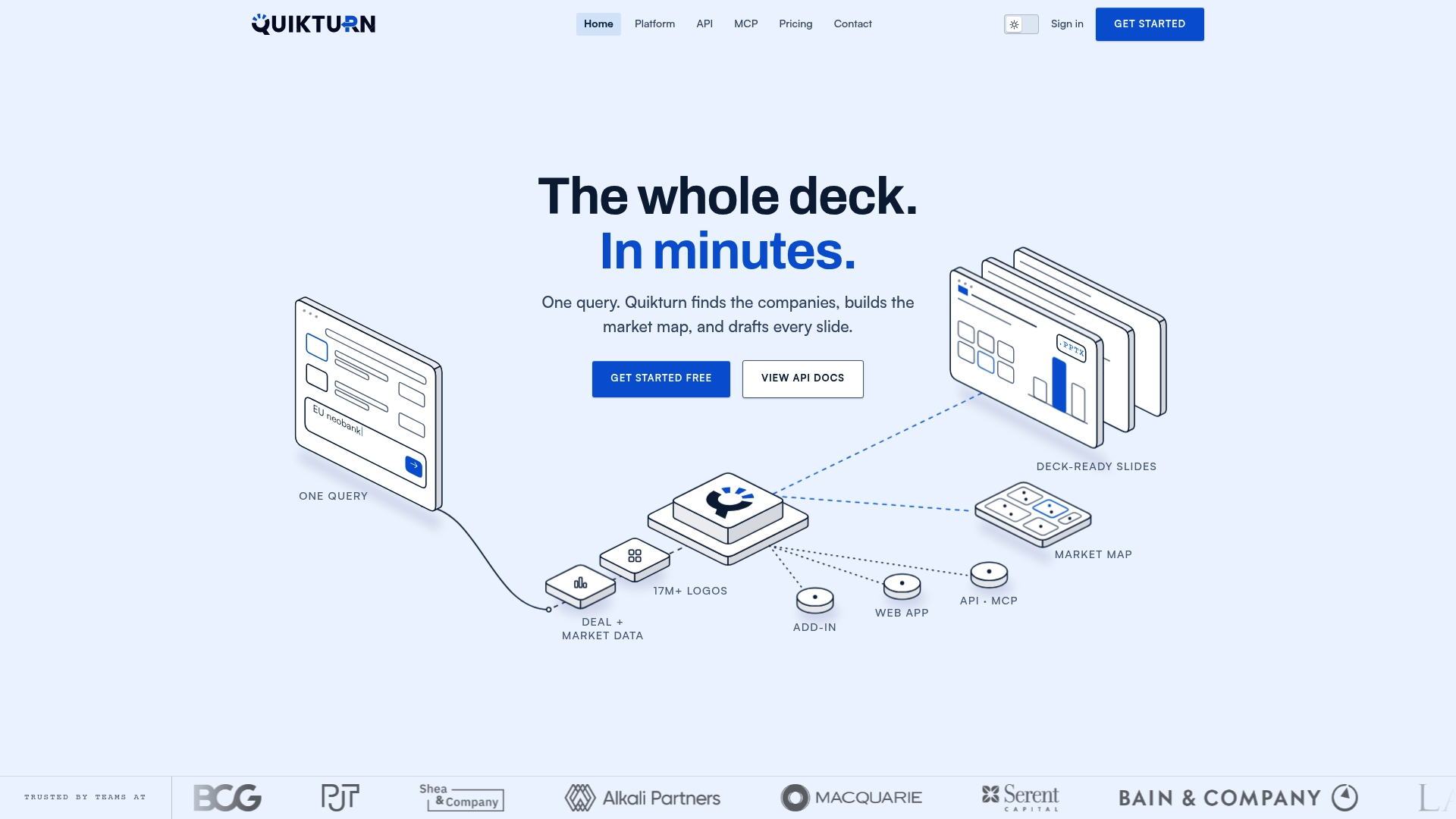
You can run it as a web platform, a PowerPoint add-in, or through the API, so it fits whatever your team already uses for private equity portfolio reporting or investment banking pitch decks. A reasonable pilot: connect two source systems, configure one memo or deck template inside Quikturn, and run five deals through it end to end before deciding whether to scale. Enterprise teams get added security controls and no storage of presentation content, which matters when you're handling live deal data (see the enterprise solutions page for details).
Plans start with a free tier, and paid plans unlock higher usage and additional features. Current pricing details are available on the pricing page. Check current pricing and plans and get your first deck or memo section built in the next few minutes.
Further Reading on Governance and Architecture
For deeper technical grounding, see the NIST AI RMF generative AI profile on governance functions and the FundaPod research paper on multi-persona agent architecture and provenance design.
Sources
Start with the most structured and auditable sources: your Excel financial model, signed term sheets, EDGAR filings, and formal diligence reports. CRM notes and call transcripts add useful context but need more verification before feeding directly into a memo.
- Artificial Intelligence Risk Management Framework (AI RMF) — Generative AI (NIST)
- FundaPod: Multi-persona agent platform for AI-assisted fundamental investment research (arXiv)
- Progressive funnel and embedding-based AI framework (Research Square)
FAQ
What Is Investment Memo Automation?
Investment memo automation uses AI to pull data from decks, models, and other documents, verify it, and draft structured memo sections automatically. It speeds up assembly and enforces consistent formatting, but the final investment recommendation still requires analyst review.
Can AI Write the Entire Investment Memo?
AI can reliably draft high-readiness sections like financial summaries, company facts, and term-sheet fields. The investment thesis and final recommendation should stay human authored, since these require judgment no extraction pipeline can replicate.
How Much Time Does Automation Actually Save?
Industry accounts describe automation shifting memo prep from multiple days down to a few hours once structured data assembly and source-linked drafting take over the repetitive work. Actual savings depend on how clean your source systems are and how much manual review your pilot still requires.
Does Quikturn Handle Investment Memo Drafting?
Quikturn focuses on the data assembly layer: pulling verified company details, logos, and market intelligence into slides and memo templates through its web app, PowerPoint add-in, or API. It removes the manual research and formatting work, letting analysts spend more time on the actual analysis.
What Are the Biggest Risks in Automating Memos?
The two main risks are hallucination, where a model states a confident but unsupported figure, and omission, where a material fact never makes it into the draft. Both are reduced significantly by requiring a sourced evidence link for every automated claim and a human review gate before committee.