
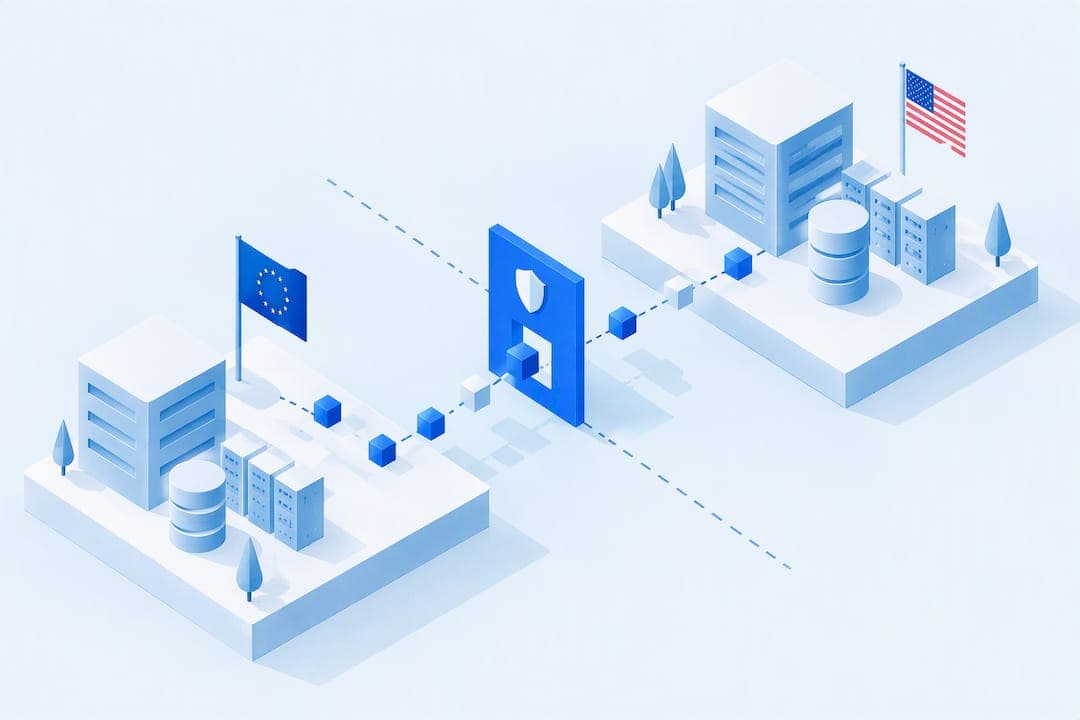
Data residency is not a checkbox your legal team ticks after launch. It is a cross-functional design constraint that touches your database schema, your backup jobs, and your vendor contracts. The immediate priorities are inventorying your data classes, mapping every flow those classes take, assigning each tenant to a region, and locking vendor obligations into contracts before your next enterprise renewal.
TL;DR:
- Data residency enforcement requires comprehensive technical controls, contract updates, and an inventory of all data classes, including logs and backups.
- Legal review is necessary whenever data crosses borders due to transfer restrictions or localization mandates, especially for EU or country-specific regulations.
- Building region-aware architecture with canonical tenant metadata and sharding prevents costly retrofits and reduces the risk of unnoticed cross-region data leaks.
- Relying solely on infrastructure controls is insufficient; deploy DSPM tools and enforce contractual oversight to verify subprocessors and vendors honor residency obligations.
- Regularly test and document residency enforcement through impact assessments, automated audits, and incident playbooks to ensure compliance and audit readiness.
Table of Contents
- Key takeaways for founders and compliance leads
- Data residency versus sovereignty versus localization
- The regulatory map: EU rules, U.S. complexity, and beyond
- The hidden costs of treating residency as an afterthought
- Architecture patterns that make residency enforceable
- Vendor contracts, DSPM, and proving it with evidence
- Testing, incident response, and audit readiness
- A 12-step implementation roadmap
- How SaaS vendors approach data residency differently
- Why residency belongs on the platform roadmap, not the compliance backlog
- Where Quikturn fits into a secure enterprise workflow
- Primary sources worth reviewing directly
- Sources
- FAQ
Key takeaways for founders and compliance leads
Residency programs fail when one team assumes another owns the problem. Engineering typically owns tenant-to-region assignment, region enforcement, and backup isolation. Legal and compliance own contract language, vendor due diligence, and regulatory interpretation. Product and sales own the customer-facing commitments that engineering then has to honor.
- Engineering builds and enforces the technical controls; compliance defines the policy those controls must satisfy.
- Legal review is required before any contractual residency promise reaches a customer, since a vague promise can become an unenforceable liability.
- A minimum short-term checklist covers three items: a documented data inventory, at least one enforced region-restriction control, and updated subprocessor disclosures in your contracts.
Most enterprise procurement teams will accept a documented plan with a realistic timeline over a vague "we're compliant" answer. What they will not accept is silence when asked where a specific data class lives.
Data residency versus sovereignty versus localization
These three terms get used interchangeably, but they describe different obligations, and mixing them up leads to the wrong architecture.
- Data residency describes where data is physically stored. A customer or regulator specifies a country or region, and your system must keep the covered data there.
- Data sovereignty goes further: it asks which country's laws govern the data, regardless of where it sits. A server in one country can still be subject to another country's legal reach through mechanisms like the CLOUD Act.
- Data localization is a legal mandate, usually from a government, requiring certain data types to stay within national borders as a matter of law rather than customer preference.
The practical difference shows up in how transfer mechanisms change your obligations. Residency is often satisfied by picking the right region at provisioning time. Sovereignty can require you to change vendors, since even a compliant region choice does not block a foreign government's legal request to a cloud provider headquartered elsewhere. Localization removes the choice entirely: the law tells you where the data must live, full stop.
For a SaaS company, "resident data" usually includes customer records, uploaded files, application logs tied to an identifiable customer, and search indexes built from that content. It does not typically include anonymized product analytics, though teams frequently assume it does not when it actually does, because anonymization is harder to verify than it sounds. When in doubt, treat any data field that can be traced back to a named tenant as resident data until legal confirms otherwise.
The regulatory map: EU rules, U.S. complexity, and beyond
You do not need to become a lawyer to build compliant architecture, but you do need to know when a decision requires legal sign-off versus when engineering can act alone.
In the EU, transferring personal data outside the European Economic Area requires a legal basis: an adequacy decision, Standard Contractual Clauses, or Binding Corporate Rules. For a SaaS company, this means every subprocessor and every backup region touching EU customer data needs a documented transfer mechanism, not just a good intention. A support engineer accessing a European customer's data from outside the EEA can itself count as a transfer, which surprises teams that only think about where the database lives.
The United States has no single federal data residency law. Instead, SaaS companies face a patchwork: state privacy laws such as those in California and Virginia, sectoral rules like HIPAA for health data, and the CLOUD Act, which lets US law enforcement compel American providers to produce data regardless of where it is stored. That last point matters for sovereignty conversations with international customers who assume a European data center puts their data outside American legal reach. It does not, if the provider is a US company.
Other jurisdictions add outright localization mandates rather than transfer restrictions. Some countries require certain data categories, often financial or health records, to stay on domestic soil with no transfer mechanism available at all. That is a materially different obligation than the EU's transfer-permission model, and it usually means a dedicated regional deployment rather than a contractual workaround.
- Engineering can act alone when the requirement is a straightforward region pin with no cross-border access pattern.
- Legal review is required whenever a support workflow, subprocessor, or backup job crosses a border covered by a transfer restriction or localization mandate.
- Escalate immediately when a customer contract promises a residency guarantee your current architecture cannot enforce.
Building this map once, and keeping it current as you add subprocessors, saves you from discovering a gap during a customer's security review.
The hidden costs of treating residency as an afterthought
Retrofitting residency after a system is built costs more than building it in from the start, and the costs show up in places founders rarely budget for.
Regulatory fines are the most visible risk, but the more common cost is lost or delayed deals. Enterprise buyers in regulated industries increasingly ask for a residency commitment during procurement, and a "we'll figure it out" answer often ends the conversation. Infrastructure retrofits are expensive because migrating an existing multi-tenant database into region-isolated shards without downtime is a significant engineering project, not a configuration change.
- Sales friction: deals stall or shrink in scope when you cannot commit to a customer's region requirement in writing.
- Migration cost: moving live tenants between regions after the fact requires the same copy-and-verify rigor as a database migration, plus a rollback plan.
- Technical debt: backups, logs, and analytics pipelines built before anyone thought about residency often replicate data outside the required region without anyone noticing until an audit asks.
That last point is the one that catches experienced teams off guard. A primary database can be perfectly region-pinned while a nightly backup job, a centralized logging pipeline, or a product analytics event stream quietly copies the same data to a different continent. Atlassian's engineering team has described exactly this pattern: primary data stores are often the easy part, while backups, telemetry, and support tooling are the recurring leakage points that undermine an otherwise sound residency design.
Architecture patterns that make residency enforceable
Residency has to be a property of your system's design, not a policy layered on top of it after the fact. The teams that get this right build a small number of core patterns early.
- Canonical tenant-to-region metadata. A central catalogue service should hold the single source of truth for which region each tenant belongs to, and every other service queries that catalogue rather than storing its own copy of the assignment.
- Sharding over global replication. Sharding your data by region, rather than replicating a global database everywhere, keeps each tenant's data physically bound to one location and avoids the cost and risk of syncing sensitive records across continents.
- Region-aware backups, logs, and analytics. Every artifact your primary system produces, including nightly backups, error logs, and telemetry, needs the same region tagging as the source data, or it becomes the leak.
- Migration as atomic copy-then-delete. Moving a tenant between regions should be modeled as a copy operation that completes and verifies before the source is deleted, with a rollback path if verification fails.
- Cloud provider sovereignty controls. AWS documents region deny policies, Dedicated Local Zones, and scoped KMS keys as preventive and detective controls that reduce the chance of data leaving its assigned region even when a misconfigured service tries to write outside it.
This is the same approach Atlassian describes in its own cloud architecture: a catalogue service holding canonical tenant-to-region metadata, per-service shards, and migration flows with explicit copy and delete semantics rather than a simple region flag on a database row.
Pro Tip: Treat your backup and logging pipelines as first-class residency surfaces during design review, not as an afterthought you audit later.
Disaster recovery planning has to respect the same boundaries. A failover region for a EU-resident tenant cannot be a US data center just because it is the next one in your standard runbook.

Vendor contracts, DSPM, and proving it with evidence
Your own architecture is only half the picture. Every subprocessor, analytics vendor, and support tool you rely on inherits your residency obligations, and you need contractual and technical controls to prove they honor them.
NIST's supply chain risk management guidance recommends maintaining a full supplier inventory and prioritizing oversight by criticality rather than treating every vendor the same way. A payment processor handling resident financial data warrants deeper scrutiny than a marketing analytics tool that never touches customer records.
- Require location disclosure and audit rights in every subprocessor contract, not just your top-tier vendors.
- Maintain an SBOM-style inventory of where each vendor operates and stores data, which NIST's due diligence guidance treats as a core part of provenance research.
- Deploy DSPM and DLP tooling to detect and block cross-region data movement before it becomes a violation rather than after.
A data security posture management tool can locate copies of sensitive data across cloud workloads and generate the compliance reports auditors ask for. IBM's guidance on data residency points to this kind of centralized posture tooling as the practical way to find unintended cross-region copies before a customer or regulator does. Sectoral guidance on vendor oversight, such as property management SaaS compliance practices, reflects the same principle: contractual clarity plus continuous evidence collection, not a one-time audit.
Testing, incident response, and audit readiness
A residency control you have not tested is a control you cannot prove works.
- Run a transfer impact assessment whenever you add a new subprocessor, change regions, or launch in a new jurisdiction.
- Automate tests that verify region enforcement on write paths and confirm backups stay isolated to their assigned region.
- Maintain an incident playbook specifically for residency breaches, including how and when to notify affected customers.
- Retain logs, snapshots, and compliance attestations long enough to answer an auditor's question about where data lived on any given date.
Skipping the automated tests is the most common gap. Manual spot checks catch obvious violations but miss the backup job that silently started replicating to a new region after a routine infrastructure change.
A 12-step implementation roadmap
- Inventory every data class your product collects and classify each by sensitivity and regulatory scope.
- Map the full flow of each data class, including backups, logs, and third-party tools.
- Define a per-class residency policy stating which regions are permitted.
- Build canonical tenant-to-region metadata in a central catalogue service.
- Shard core services by region rather than relying on a single global database.
- Apply region deny controls and scoped encryption keys at the infrastructure level.
- Extend region tagging to backups, logs, telemetry, and analytics pipelines.
- Update vendor contracts with location disclosure and audit rights.
- Deploy DSPM tooling to continuously monitor for cross-region data movement.
- Test tenant migration and deletion flows with rollback safety built in.
- Document a disaster recovery plan that respects each tenant's region assignment.
- Schedule recurring audits and keep evidence current for customer and regulator review.
How SaaS vendors approach data residency differently
Vendors solve this problem at different layers, and the right fit depends on how much control your team wants versus how much you are willing to hand off.
Hyperscale cloud providers offer the deepest infrastructure controls: region deny policies, scoped key management, and dedicated local zones that keep data physically and cryptographically bound to a jurisdiction. These give engineering teams granular control but require the in-house expertise to configure and maintain them correctly.
DSPM and data posture platforms sit a layer above infrastructure, scanning across multi-cloud environments to find where sensitive data actually lives rather than where it is supposed to live. These tools are valuable precisely because architecture diagrams and reality tend to drift apart over time.

Purpose-built SaaS platforms, particularly those serving regulated industries like Atlassian's Jira and Confluence, bake region assignment into the product itself, letting customers pick a residency region at signup rather than negotiating it contractually. That approach shifts complexity from the customer relationship into the product, which is the direction most enterprise SaaS companies are moving as residency demands become a standard procurement question rather than an exception.
Why residency belongs on the platform roadmap, not the compliance backlog
Residency work competes with feature velocity, and it usually loses that fight until an enterprise deal stalls over a question nobody can answer. The trade-off is real: building region-aware infrastructure early costs sprint time you would rather spend on product. But retrofitting it later costs far more, in engineering hours and in deals lost while you scramble to catch up.
Start small. An honest data inventory and a minimum viable residency plan beat a perfect architecture diagram that never ships.
— Quikturn Team
Where Quikturn fits into a secure enterprise workflow
Quikturn's enterprise offering is built for finance teams that need enterprise-grade security alongside fast deck generation, without storing presentation content long term.
If your team already has residency and vendor controls in place, evaluating tools like Quikturn becomes a straightforward security review rather than a blocker. Check pricing plans or get started to see how it fits your existing stack.
Primary sources worth reviewing directly
Legal and engineering teams building a residency program should start with primary sources rather than secondhand summaries.
- Atlassian's engineering blog on data residency details the catalogue service and shard-based patterns referenced above.
- AWS's digital sovereignty documentation covers region deny, Dedicated Local Zones, and scoped KMS controls.
- NIST's SCRM quick-start guide and due diligence assessment guide frame supplier obligations for transfer impact assessments.
- IBM's data residency primer explains DSPM's role in locating and reporting on data location.
Sources
- How we build Data Residency for Atlassian Cloud
- AWS digital sovereignty and data residency guidance
- NIST SP 1305: Cybersecurity Supply Chain Risk Management quick-start guide
- NIST SP 1326: Cybersecurity Supply Chain Management Due Diligence Assessment Quick-Start Guide
- Data residency: What is it and why is it important? | IBM
FAQ
What does data residency mean?
Data residency refers to the physical location where data is stored, often specified by a customer contract or regulation. It is distinct from data sovereignty, which concerns which country's laws apply to that data regardless of storage location.
Is GDPR still a thing?
Yes, the General Data Protection Regulation remains fully in force across the European Economic Area and continues to govern how personal data is transferred outside it. It requires a legal transfer mechanism, such as Standard Contractual Clauses or an adequacy decision, for any cross-border movement of EU personal data.
What is data residency for ChatGPT?
Data residency for AI tools depends entirely on the specific provider's infrastructure and contractual commitments, which vary by product and enterprise agreement. Businesses evaluating any AI tool should confirm the vendor's documented region controls directly rather than assuming a default location.
What are the 7 GDPR requirements?
Definitions of a "7 requirements" list vary by source, but GDPR's core principles generally include lawfulness and transparency, purpose limitation, data minimization, accuracy, storage limitation, integrity and confidentiality, and accountability. Organizations handling EU personal data should review the regulation's own text or consult legal counsel rather than rely on a simplified list.